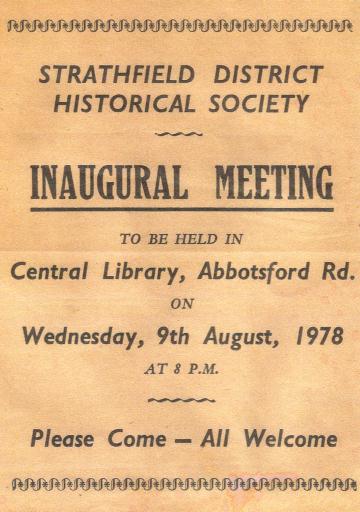
 The first Strathfield District Historical Society was established in 1978. According to NSW Fair Trading, the Society’s incorporation was cancelled and newspaper reports in 2014, stated that some members of the Society voted to wind it up. Many members were not aware of the decision to wind up nor what occurred to the Society after this decision was taken. In tribute to the early members of the Society who left a genuine legacy of research and activity, this article is dedicated to them.
The present Strathfield-Homebush District Historical Society was formed in 2018 to carry on the work of the previous society.
Moves to establish a historical society date back to the early 1970’s, when resident groups made many approaches to Strathfield Council to establish a society. The early 1970’s saw a growing interest in local history, much motivated by concern that Strathfield was undergoing physical and cultural change, yet little of its’ history had been researched, documented or preserved. This concern was not unique to Strathfield, many other local government areas such as Burwood established historical societies in similar timeframes and for similar reasons.
With increasing demand for historical information, particularly from local schools, Strathfield Council produced a booklet entitled ‘Some Notes on the Strathfield Municipality’ in 1974. Primarily written by former Strathfield Council Town Clerk, James Sandry Matthews and with the involvement of Alderman Helen L’Orange, this publication was the first official account of Strathfield’s history and copies are still available from Strathfield Library. Some care should be exercised using this booklet as it contains some inaccuracies, which were uncovered by later research. A frequently quoted ‘fact’ that Strathfield was named after the home of the ‘first Mayor John Hardie’ is contained in this publication and appears with irritating frequency. The first Mayor was George Hardie, who lived at ‘Torrington’, while John Hardy, the jeweller, lived at ‘Strathfield’. In fact Strathfield was chosen as the name of the new Municipality prior to the election of the first Council and the election of the first Mayor.
On October 19 1976, Strathfield Council adopted resolution from the Council’s General Purposes Committee with recommendations from Alderman Evan Summerfield to investigate establishing a Historical Society. The Mayor’s Report of 4th April 1977 recommended the formation of a steering committee with the purpose of establishing a Strathfield Historical Society and that the rear section of the Homebush Hall be made available to the Society.
The Western Suburbs Courier reported on 19th July 1978 that a public meeting was called by the Mayor of Strathfield Alderman Clarrie Edwards to gauge the interest in forming a Historical Society. This meeting was addressed by Mr Harry Harper of the Royal Australian Historical Society, who spoke of the objects and ideals of a society and of the appropriate steps to prepare for its formation. As over fifty residents attended this meeting, it appeared sufficient interest existed to form a Historical Society.
The first meeting of the Strathfield District Historical Society was held on 9th August 1978 with eighty-five foundation members. Guests at the first meeting included Mr Gordon Jackett MP [Burwood], the Mayor of Strathfield Alderman Clarrie Edwards and Deputy Mayor Rod Thurgar. The Western Suburbs Courier of 23rd August 1978 reported that Sir William and Lady Sonia McMahon supported the establishment of the Society by becoming Foundation members. At the meeting, the Mayor handed over the keys to new premises, the former Homebush Library Building at 75 Parramatta Rd Homebush. Office bearers were elected at the first meeting, which included: President: Mr M B Moroney; Vice-President: Mr Brian McDonald; Secretary: Mrs Trudi O’Neill; Treasurer: Mrs Doreen Rich; Committee Members: Brian McDonald, Syd Malcolm, Mary Farr, Julie Corbett, Lorraine McDonald and Joan Reaby. One of the first resolutions of the Society was to seek affiliation with the Royal Australian Historical Society.
The Society’s first newsletter issued in February 1979. The objective of the newsletter has been publication of research, particularly relating to the Strathfield District. Over the last 25 years, a number of Society members have been regular contributors to the newsletter. Early editions featured the work of Syd Malcolm, who particularly excelled in his comprehensive and detailed research of many of Strathfield’s historic properties and estates. Syd also recorded and transcribed many oral histories of long-term residents and through this work, Strathfield gained valuable insight into periods such as late nineteenth century Strathfield, which could not be recorded today as too much time has elapsed. Our knowledge of Strathfield’s educational establishments, a major feature of Strathfield, has been greatly enhanced by the contributions of Arthur Hall. Important contributions, notably on ‘Mount Royal’, were made by Brother A I Keenan of Mount St Mary College. Trudi O’Neill, a former Secretary, wrote many articles such as ‘Early Maps of Australia’, which contributed another area of historical interest.
Many of the research tasks were performed by Reg Kennedy after the death of Syd Malcolm in 1983. Reg’s keen interest in history encompassed many fields. His research ranges from biographical works including Thomas Rose, Simeon Lord, Frederick Meredith and James Wilshire to the long historical series on Parramatta Road. His enthusiasm for heritage conservation shines through his many articles on properties either threatened by demolition or redevelopment such as ‘Glen Luna’ or ‘Fairholm’ or his passionate critiques on the changing style of residential buildings in Strathfield. Reg Kennedy provided considerable historical research to the 1986 Council Heritage Study, a critical factor in determining heritage status, and following this work, his writings are notably more focussed on architectural styles and heritage issues. Following Reg’s death in 1991, Lucy Stone was the primary researcher and contributor to the Society’s newsletter, a difficult task she performed for over a decade as well as fulfilling all the administrative demands of her role as Secretary. Her outstanding contribution to the Society was recognised in December 2002 with the award of Life Membership of the Strathfield District Historical Society. Cathy Jones wrote the newsletters from 2001 to 2011, when she stood down as Secretary. Following 2011, newsletters were issued occasionally until the Society ceased operating in 2014.
The work of artist Ted De Sauty was synonymous with the Strathfield District Historical Society as Ted’s illustrations provide the visual focus for the work of the Society. In his paintings, Ted recreated visions of historic properties long demolished including ‘Strathfield House’ and ‘Bickley’. His water-colour painting of ‘Strathfield House’ appears on the cover of ‘Oasis in the West’ and his sketch of Strathfield House is featured on the Society’s letterhead. Ted’s paintings offer a stylish interpretation of Strathfield’s past and for many, define the unique qualities of Strathfield.
Formed under the auspices of Strathfield Council, the Society has worked in collaboration with the Council on many projects and events such as the Strathfield Council Centenary celebrations in 1985, many Australia Day Celebrations, Australia Remembers [50th Anniversary of the end of WWII in 1995], 125th Anniversary of the Council in 2010, National Trust Heritage Festival Events and organising photographic displays. The Society has made considerable research contributions to Council projects such as the Strathfield’s official history ‘Oasis in the West’ [1985], and Heritage Studies.
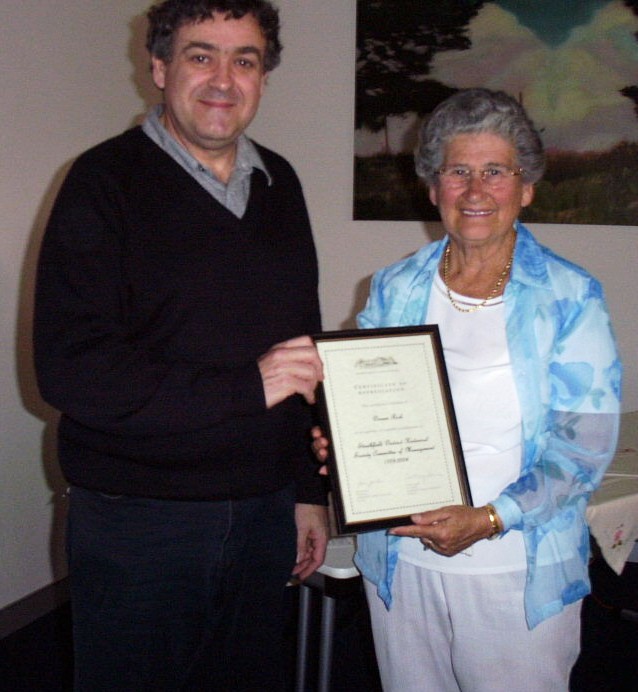
There are many members, who have not been mentioned, whose contributions to the Society were considerable such as previous office holders and committee members including long serving President Doreen Rich, officeholders Peter Bourke, Margaret Thurn, Jan Jenkins, Claire Jones, Nancy Hardie, Michael Nicholls, Bernice Harkness and Charles Pitt, who served as the honorary auditor for many years.
 Strathfield-Homebush District Historical Society